Journal Impact and Statistics

IJES Citation Impact and Scholarly Visibility

This page presents selected citation and impact indicators for the International Journal of Economic Sciences (IJES). The visualizations summarize citation visibility across major scholarly databases, citation performance by publication cohort, the breadth of citation impact, highly cited articles, cited-document coverage, and cross-database recognition of leading IJES publications.

Citation Overview

Citation data for IJES are available across the major scholarly databases. The citation sources used for the statistics presented on this page can be accessed directly below.

Citation data were collected in August 2026. Citation counts may increase over time as the respective scholarly databases are continuously updated.

Citation Visibility Across Major Scholarly Databases

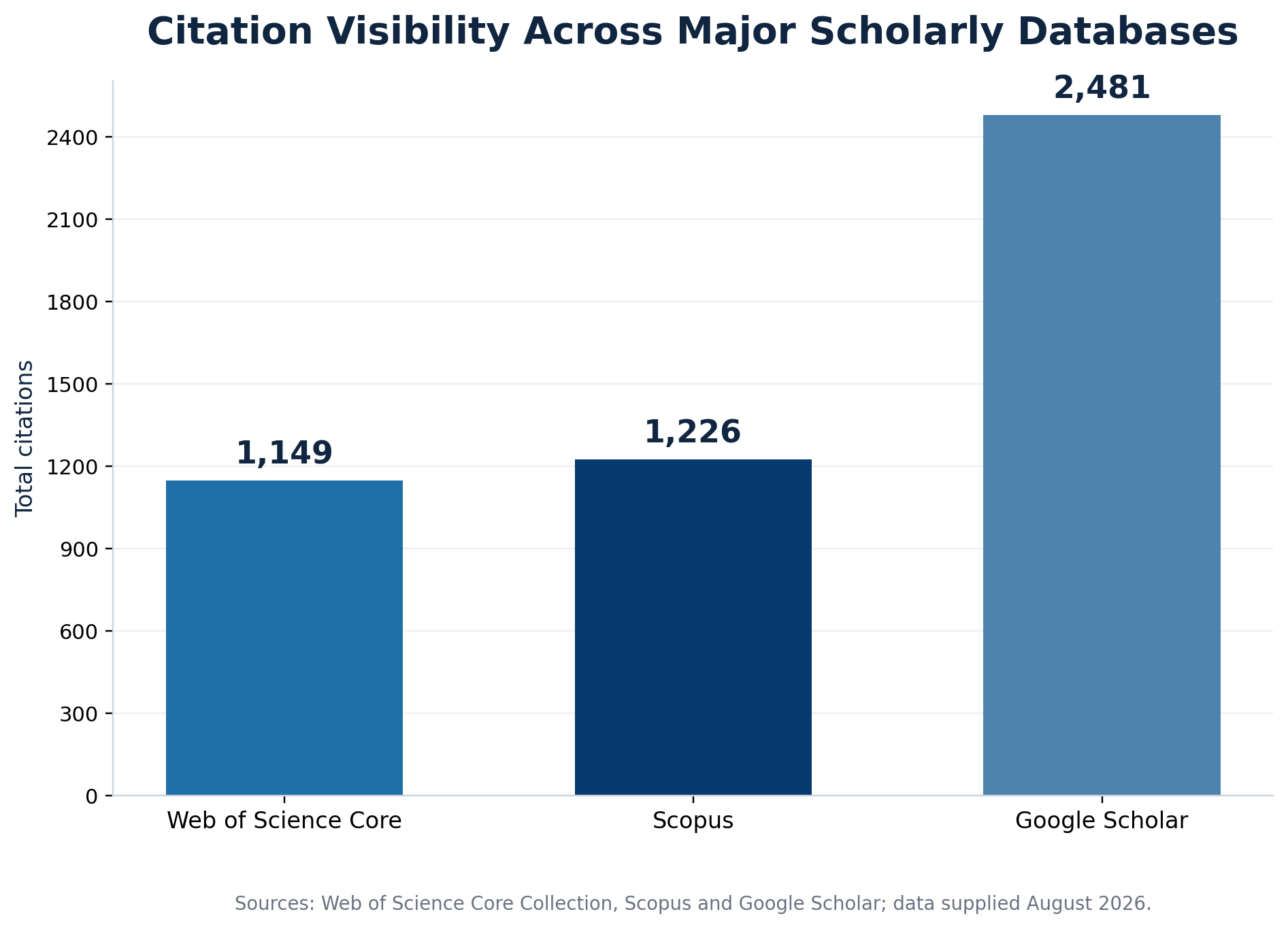
IJES demonstrates substantial citation visibility across the major scholarly databases. The journal has received 1,149 citations in Web of Science Core Collection, 1,226 citations in Scopus, and 2,481 citations in Google Scholar. The presence of substantial citation counts across multiple independent databases indicates that the scholarly influence of IJES is not limited to a single indexing environment.

Click the figure to enlarge

Scopus Citation Impact by Publication Year

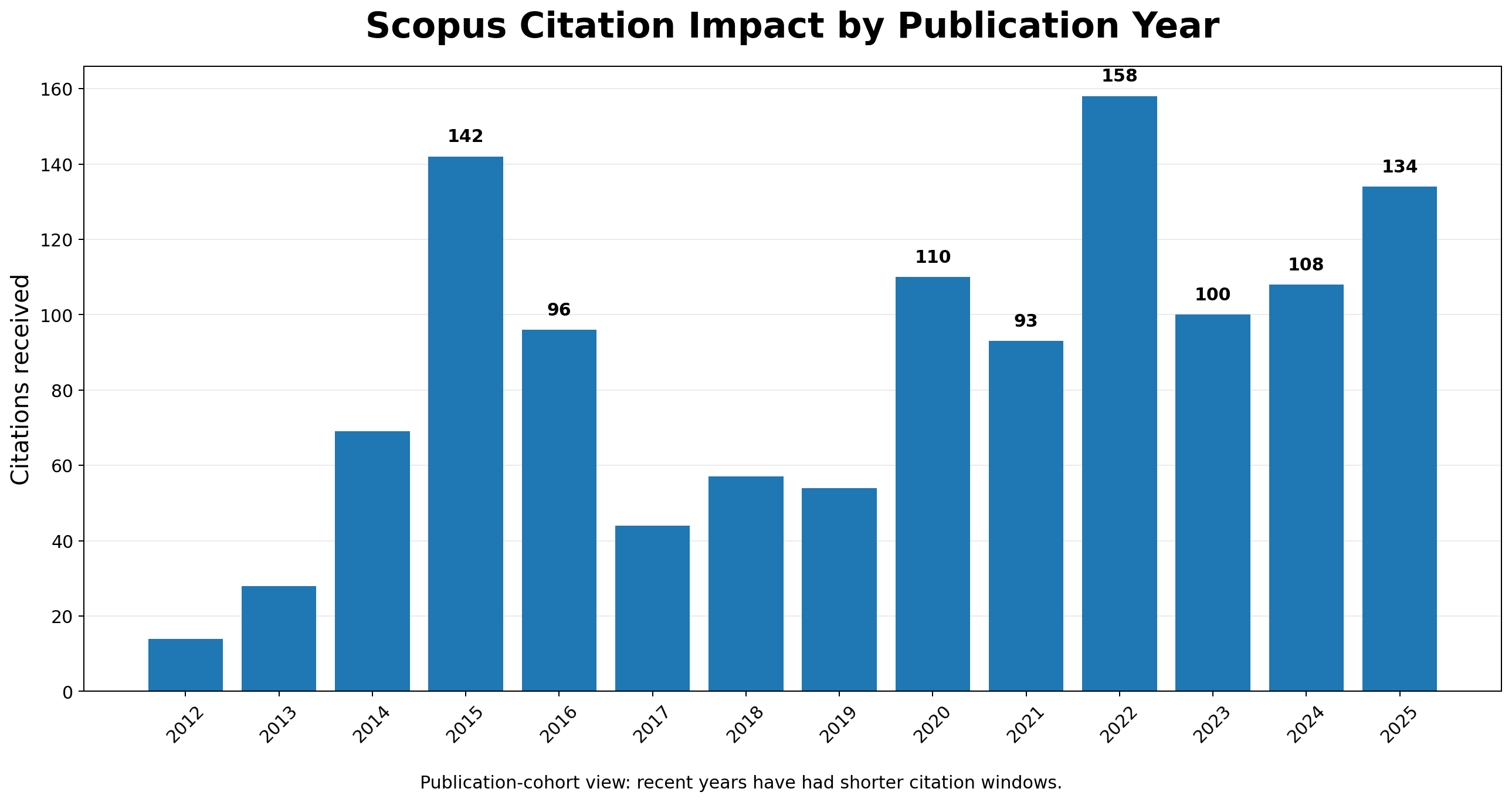
The publication-cohort analysis shows that IJES articles have generated citation impact across successive publication years. Particularly strong citation performance can be observed for several cohorts, including 158 citations for the 2022 cohort, 142 citations for 2015, and 134 citations for 2025. The strong citation activity of recent publication cohorts is especially notable because these articles have had substantially shorter citation windows.

Click the figure to enlarge

Web of Science Core Citation Impact by Publication Year

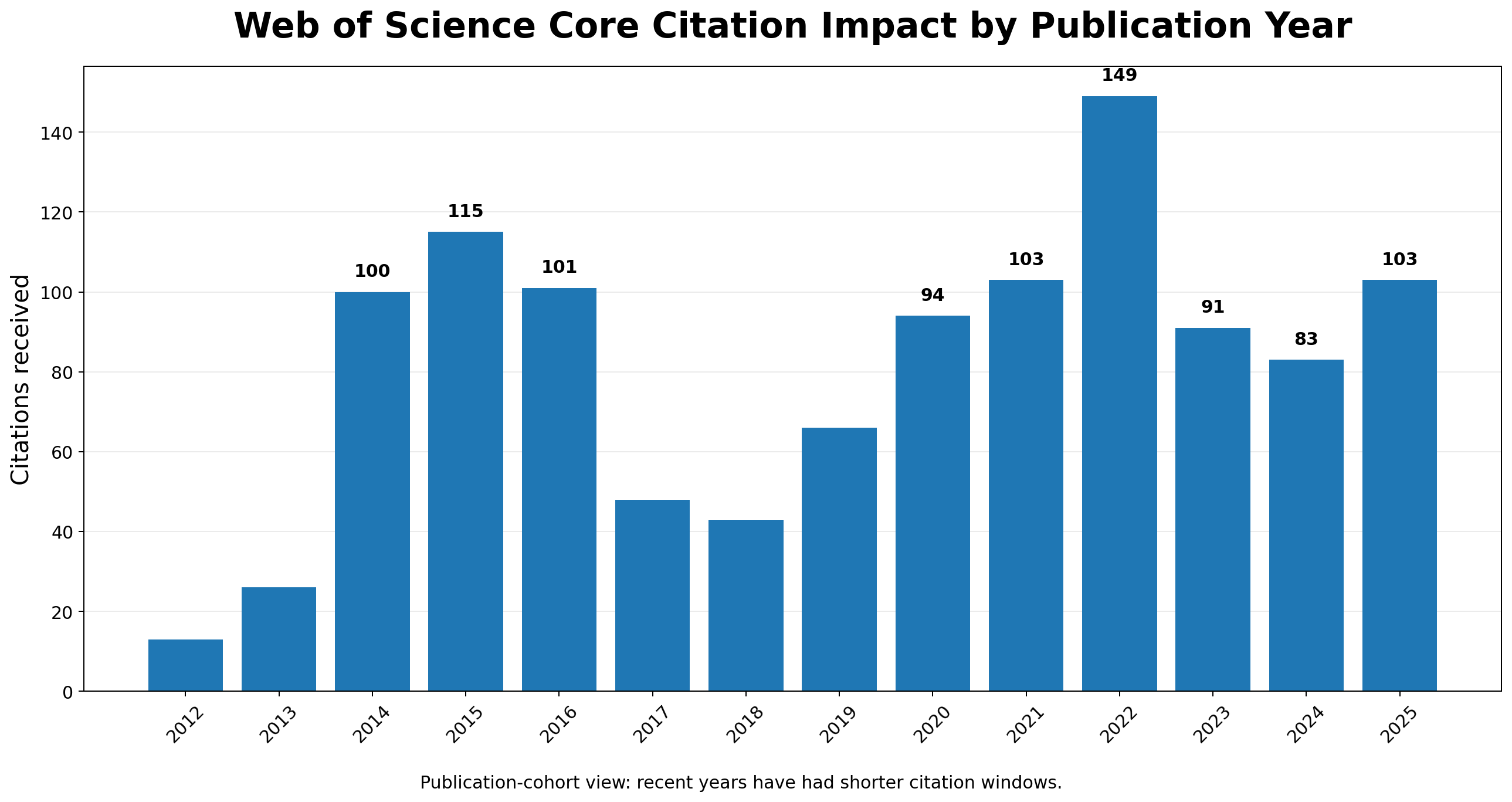
Web of Science Core Collection data confirm sustained citation recognition across IJES publication cohorts. The 2022 cohort has received 149 citations, while the 2015 cohort has received 115 citations. Recent articles also demonstrate substantial visibility, with the 2025 cohort already reaching 103 citations, despite its considerably shorter period of exposure to the scholarly community.

Click the figure to enlarge

Recent Citation Performance of IJES Publication Cohorts

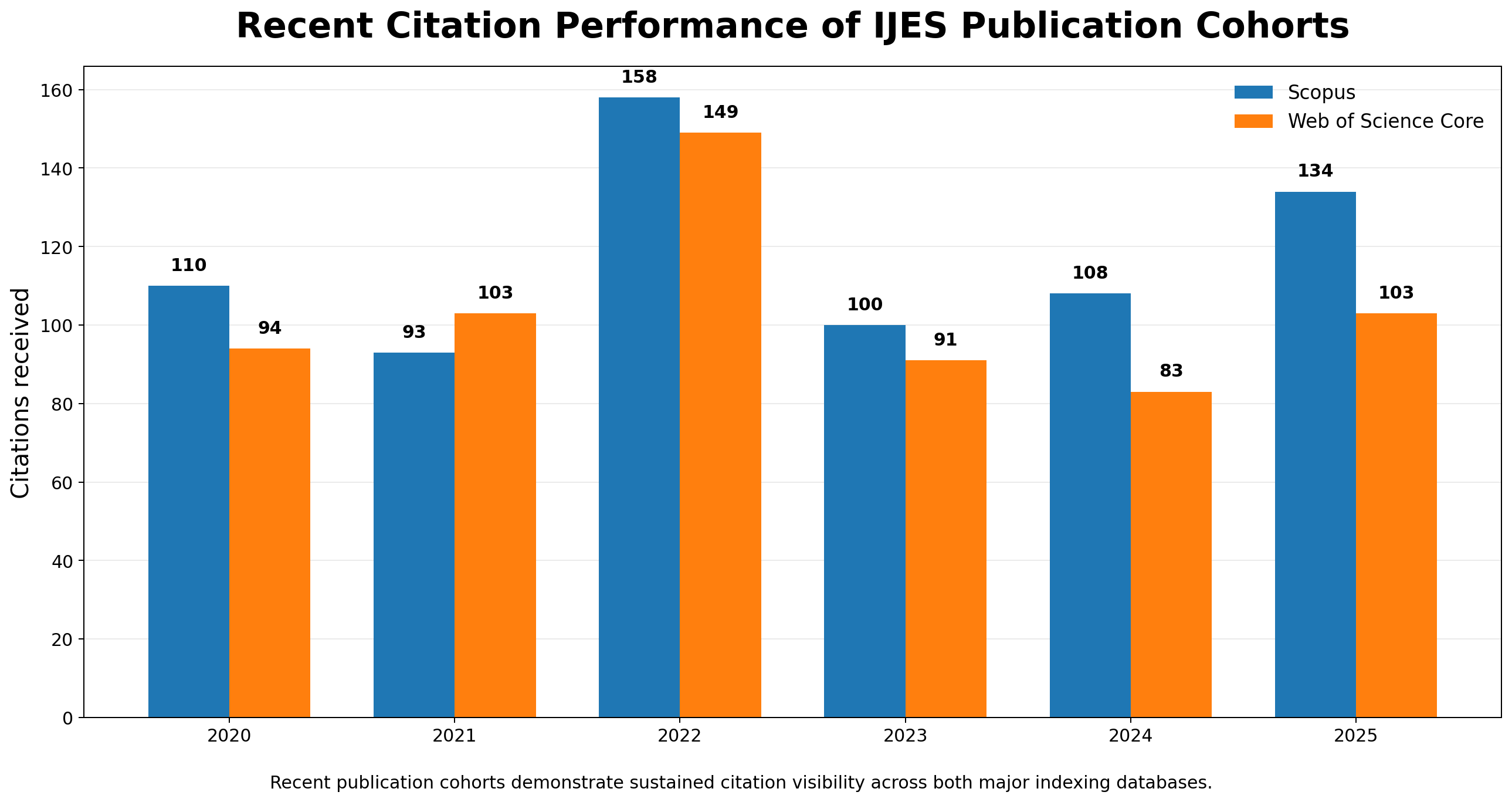
A comparison of recent publication cohorts demonstrates substantial citation visibility in both Scopus and Web of Science Core Collection. The results are particularly encouraging for recent volumes: the 2022 cohort reached 158 Scopus and 149 Web of Science citations, while articles published in 2025 have already accumulated 134 Scopus and 103 Web of Science citations. This provides evidence of continuing citation activity among recently published IJES research.

Click the figure to enlarge

Breadth of Scopus Citation Impact

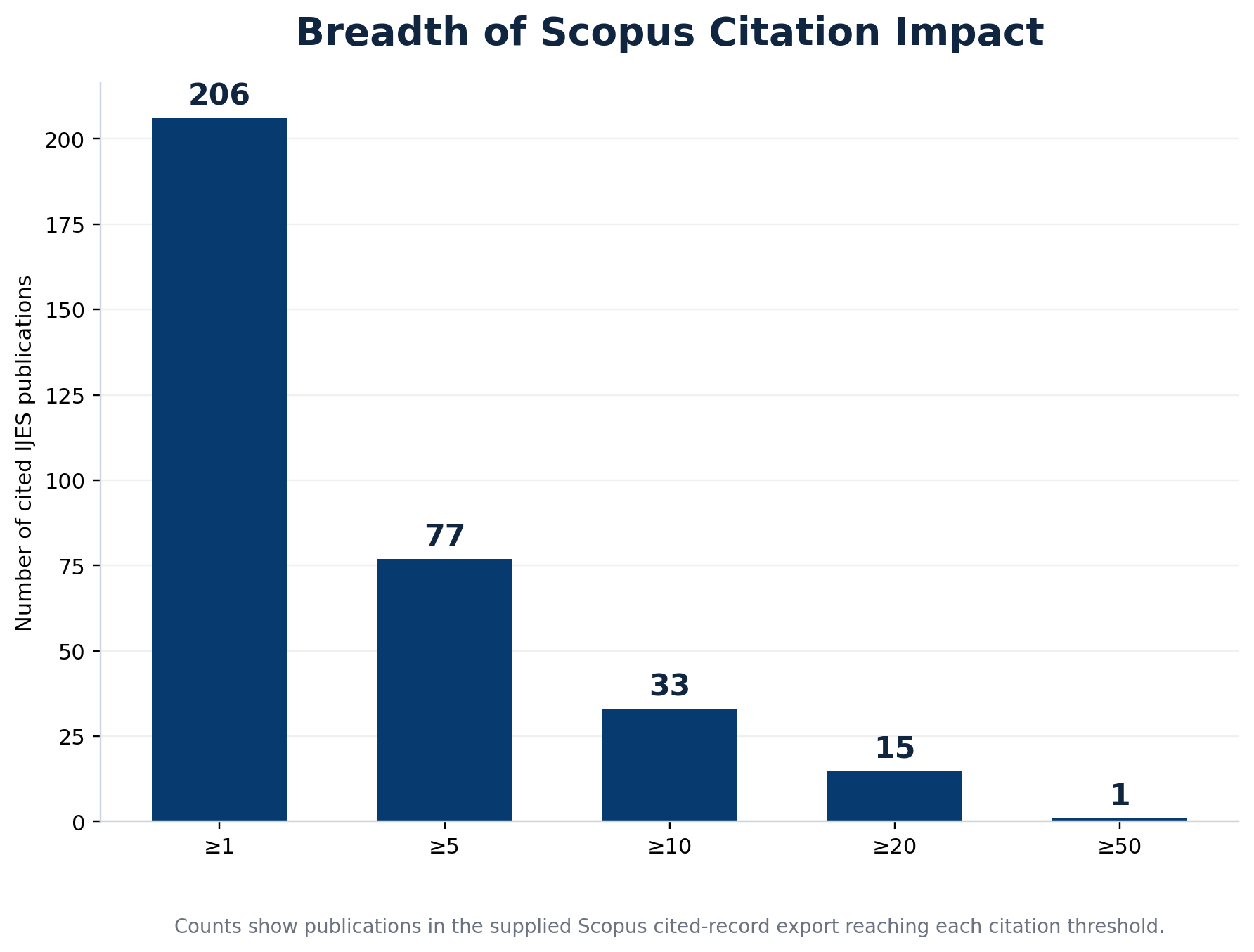
The citation impact of IJES is distributed across a broad part of its publication portfolio rather than being concentrated in only a few articles. According to the analyzed Scopus records, 206 publications have received at least one citation, 77 have received at least five citations, 33 have reached at least ten citations, and 15 publications have received 20 or more citations. This distribution demonstrates breadth of scholarly use across the journal's published content.

Click the figure to enlarge

Web of Science Cited-Document Coverage

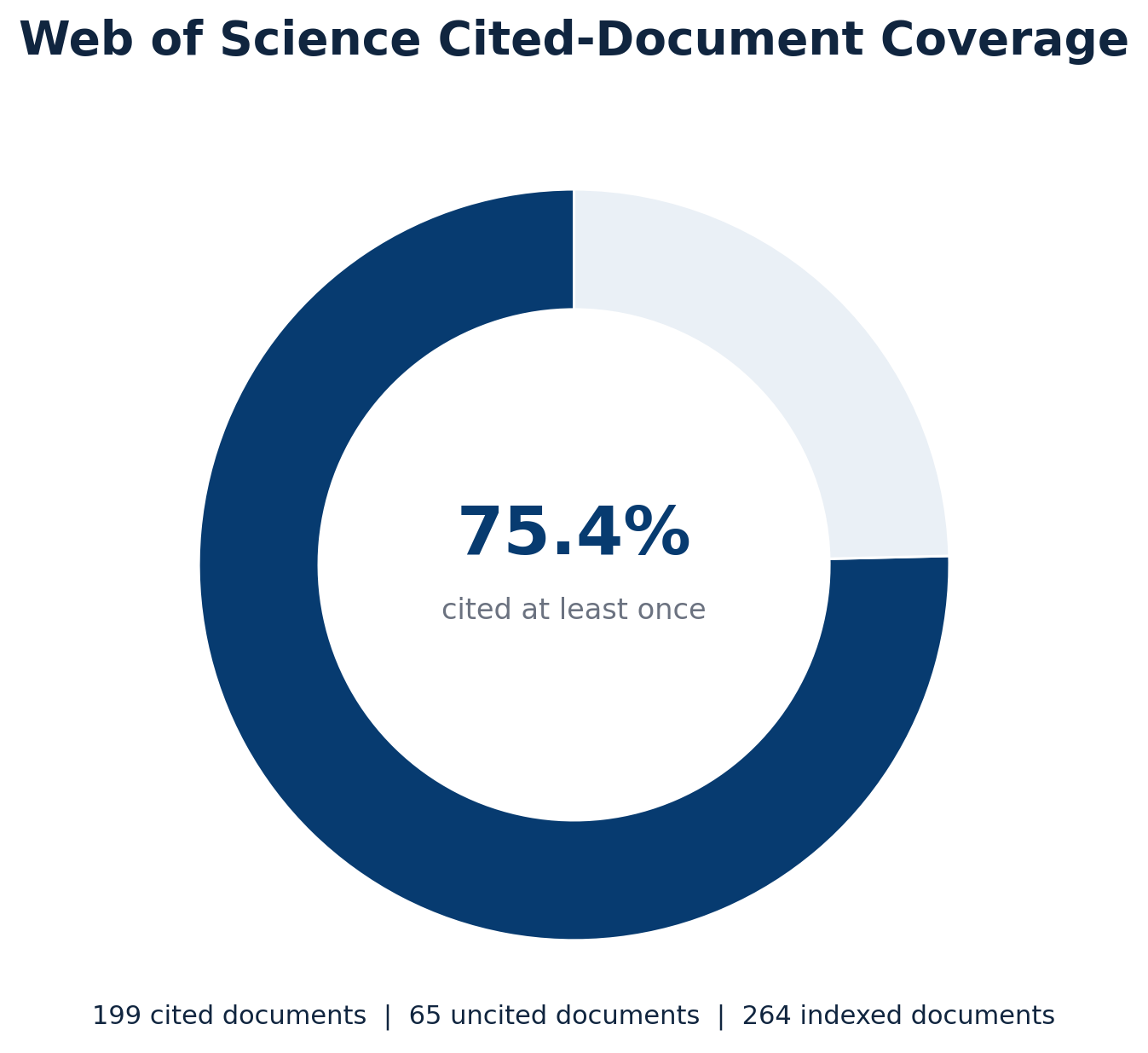
Citation impact is also broadly distributed across IJES publications indexed in Web of Science. Of the 264 indexed documents analyzed, 199 have been cited at least once, corresponding to a 75.4% cited-document coverage rate. This indicates that citation recognition extends across a substantial majority of the journal's indexed publication portfolio.

Click the figure to enlarge

Most Cited IJES Articles in Scopus

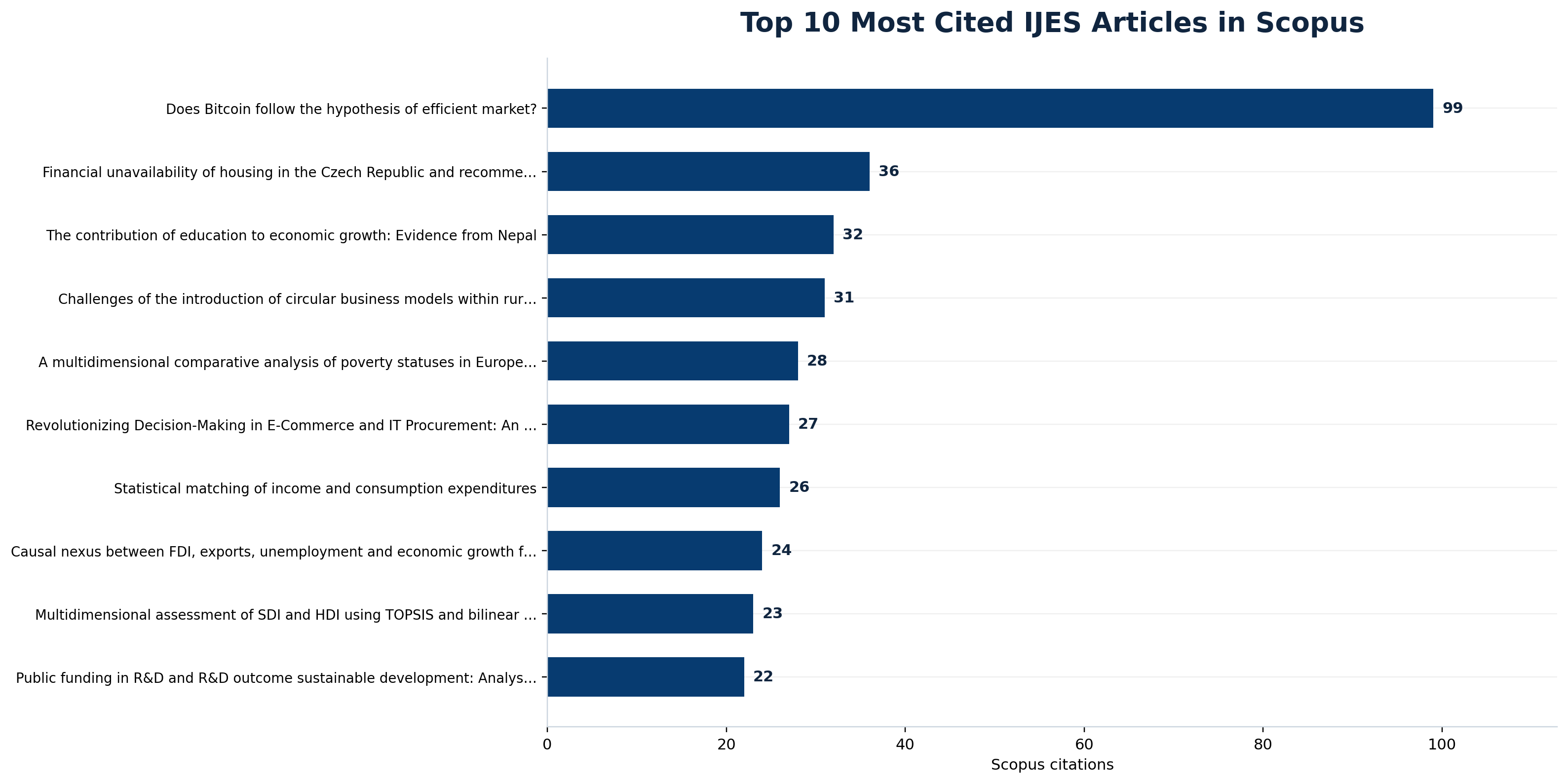
The most cited IJES publications demonstrate the journal's capacity to publish research that attracts substantial scholarly attention. The leading article has accumulated 99 Scopus citations, while a broader group of highly cited papers has received more than 20 citations each. The distribution among the leading papers also indicates that citation impact extends beyond a single highly cited publication.

Click the figure to enlarge

Cross-Database Citation Recognition of Leading IJES Articles

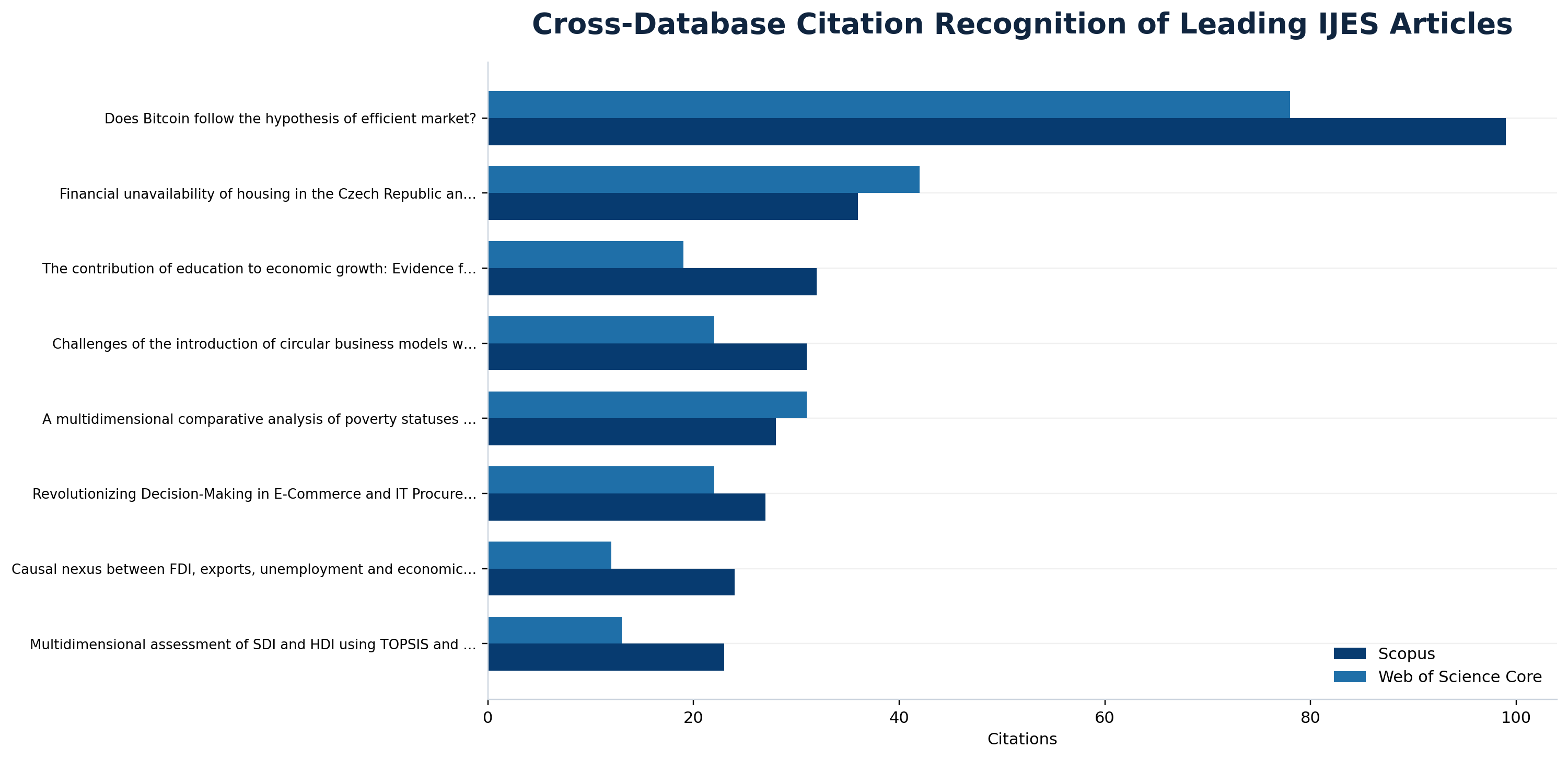
Leading IJES articles demonstrate citation recognition across both Scopus and Web of Science Core Collection. The presence of the same publications among highly cited records in both databases provides independent cross-database evidence of scholarly visibility. This pattern indicates that the citation performance of leading IJES research is observable across different major international indexing systems.

Click the figure to enlarge

Data availability. The bibliometric statistics presented on this page are based on citation records obtained from Scopus, Web of Science Core Collection and Google Scholar.

Scopus source data: IJES Scopus dataset

Geographic Distribution of the IJES Editorial Team

The IJES editorial team reflects a broad international academic network. The current editorial structure comprises 43 editors from 19 countries. The largest representations are from the United States (18.60%), the Czech Republic (13.95%), Hungary (9.30%), Italy (6.98%), and Israel (6.98%), demonstrating the journal's broad international editorial representation.

United States 8   (18.60%)
 
Czech Republic 6   (13.95%)
 
Hungary 4   (9.30%)
 
Italy 3   (6.98%)
 
Israel 3   (6.98%)
 
Countries represented by two editors
Bosnia and Herzegovina — 2 (4.65%)    |    Canada — 2 (4.65%)    |    France — 2 (4.65%)    |    Norway — 2 (4.65%)    |    Poland — 2 (4.65%)
Countries represented by one editor
Chile — 1 (2.33%)    |    China — 1 (2.33%)    |    Gibraltar — 1 (2.33%)    |    Japan — 1 (2.33%)    |    Netherlands — 1 (2.33%)    |    Slovenia — 1 (2.33%)    |    South Korea — 1 (2.33%)    |    Spain — 1 (2.33%)    |    United Kingdom — 1 (2.33%)
International editorial representation. The IJES editorial team comprises 43 editors representing 19 countries, illustrating the international character and geographic diversity of the journal's editorial community.